
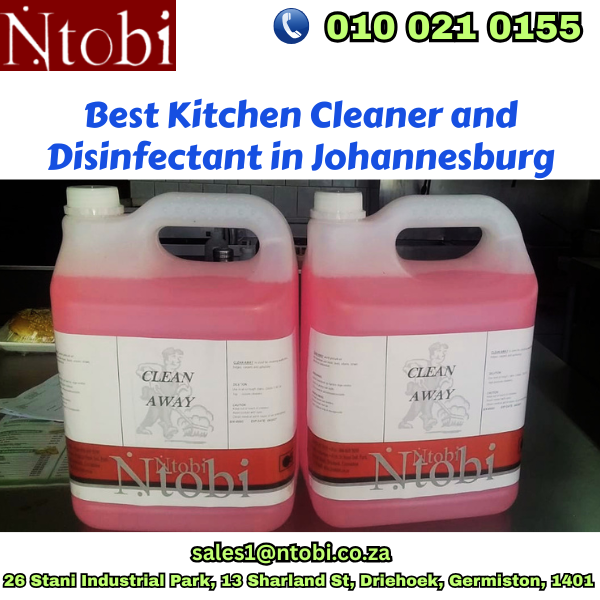
The best kitchen cleaner and disinfectant in Johannesburg combines food-safe germ elimination with grease-cutting power, without leaving residue on surfaces that contact food. Ntobi Cleaning Supplies stocks a range of household and commercial cleaning products formulated specifically for South African kitchen environments, from domestic countertops to commercial prep surfaces.
Key Takeaways
- The best kitchen cleaner and disinfectant in Johannesburg must kill bacteria and viruses while being safe for food-contact surfaces
- Pine disinfectant remains one of the most trusted and cost-effective kitchen disinfectants in South African homes
- Dish soap formulated with degreasing agents tackles cooked-on oils that general-purpose sprays miss
- Dilution ratios matter, a product used at the wrong concentration either under-performs or damages surfaces
- Johannesburg’s hard water affects how cleaning products lather and rinse, so surfactant quality is critical
- Buying cleaning concentrates in bulk from a local wholesaler reduces cost per litre significantly
What Makes a Kitchen Cleaner and Disinfectant Effective
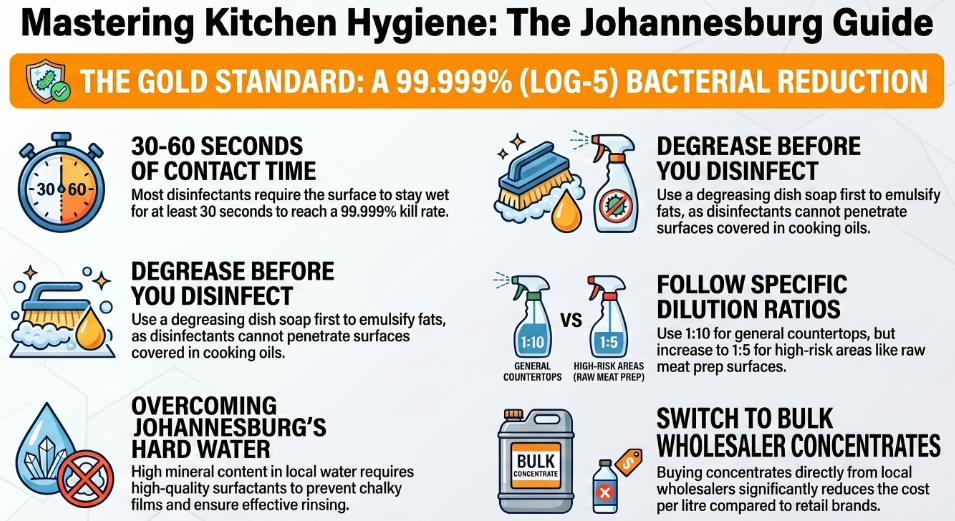
The kitchen carries a higher contamination risk than most rooms in a home. Raw meat, dairy, and fresh produce introduce Salmonella, E. coli, and Listeria to countertops, chopping boards, and sink basins daily. A genuine kitchen disinfectant must carry a log-5 kill rate, meaning it reduces bacterial populations by 99.999% at the recommended contact time.
Most spray-and-wipe products sold at retail do not reach this threshold unless the surface stays wet for at least 30 seconds. Many users spray and immediately wipe, leaving inadequate contact time for disinfection.
The best kitchen cleaner and disinfectant in Johannesburg also needs degreasing capability. South African cooking styles, including braai residue, frying oils, and curry pastes, leave heavy fatty deposits on stove surrounds, range hoods, and tile grout. A product that only disinfects without emulsifying fat will leave surfaces visually clean but chemically contaminated.
Ntobi Cleaning Supplies’ pine disinfectant is a phenolic-based formula that covers both requirements. Pine disinfectants have been used in South African kitchens for generations because phenolic compounds are broad-spectrum antimicrobials that also cut through light grease and organic matter.
Kitchen Disinfectant for Dishes and Sinks
Sink basins and dishwashing areas are among the most bacterially active spots in any kitchen. Food particles accumulate around drain traps, and standing water creates conditions where gram-negative bacteria multiply within hours.
The best approach for this zone is a two-step clean: a degreasing dish soap to remove organic matter first, followed by a diluted disinfectant rinse on the basin itself.
Ntobi Cleaning Supplies’ Super Brite dish soap is formulated with anionic surfactants that strip fat and protein from crockery and utensil surfaces efficiently. It rinses clearly in warm water, which matters in a city like Johannesburg where hard municipal water can leave chalky films if surfactant quality is low.
| Surface Area | Recommended Product Type | Dilution |
|---|---|---|
| Countertops | Phenolic disinfectant spray | 1:10 in water |
| Dishes and utensils | Degreasing dish soap | Neat or 1:5 |
| Sink basin | Disinfectant concentrate | 1:20 in water |
| Tile grout | Alkaline cleaner + disinfectant | Neat, scrub in |
| Refrigerator interior | Food-safe disinfectant | 1:50 in water |
Best Kitchen Cleaner and Disinfectant for Commercial Kitchens in Johannesburg
Commercial kitchens in Johannesburg face regulatory requirements under the City of Johannesburg Environmental Health guidelines. Food business operators must demonstrate that surfaces in contact with food are cleaned and sanitised to a standard that prevents cross-contamination.
For commercial environments, the best kitchen cleaner and disinfectant in Johannesburg needs to be:
- SANS-compliant where applicable for food-safe surface contact
- Concentrate-format for cost control across high-volume use
- Colour-coded system-compatible to prevent cross-contamination between food zones and bathroom zones
- Fast-acting with contact times under 60 seconds to maintain kitchen throughput
Ntobi Cleaning Supplies supplies commercial kitchen operators across Gauteng with bulk concentrates that are significantly cheaper per litre than branded retail options. Orders placed directly reduce the per-unit cost to a fraction of what is spent through a supermarket supply chain.
How to Choose the Right Kitchen Disinfectant in Johannesburg
Not all kitchen disinfectants sold in South Africa specify their active ingredient concentration, which makes comparison difficult. When evaluating the best kitchen cleaner and disinfectant in Johannesburg, check for:
- Active ingredient disclosure, phenol coefficient, quaternary ammonium concentration, or sodium hypochlorite percentage
- pH rating, alkaline products (pH 9–12) excel at grease removal while acidic products (pH 2–5) tackle mineral scale and rust staining around taps
- Food-safe certification for surfaces that contact prepared food directly
- Fragrance loading, heavily fragranced products can transfer odour to food stored nearby
Businesses sourcing cleaning products at scale will find better value through a dedicated cleaning products wholesaler in Johannesburg than through general retail distribution. Ntobi Cleaning Supplies operates as a direct-supply wholesaler, which removes the retail margin from the final price.
Frequently Asked Questions
What is the best kitchen cleaner and disinfectant in Johannesburg for home use?
Pine disinfectant diluted in warm water is the most cost-effective and proven option for South African home kitchens. It handles bacteria on countertops, sinks, and floors while cutting through light grease. Ntobi Cleaning Supplies’ pine disinfectant is available in concentrate form for home and commercial use.
Can dish soap be used as a kitchen disinfectant?
No. Dish soap removes grease and food particles through surfactant action but does not disinfect. For genuine disinfection, a separate phenolic, quaternary ammonium, or hypochlorite product must be applied after cleaning, at the correct dilution and contact time.
How often should kitchen surfaces be disinfected in a commercial setting?
High-contact surfaces, including chopping boards, prep counters, and sink surrounds, should be disinfected after every use involving raw protein. General work surfaces should be disinfected at the start and end of each service period, or every two hours during continuous operation.
Is hard water in Johannesburg a problem for cleaning products?
Yes. Johannesburg’s municipal water has elevated calcium and magnesium content, which reduces the lathering efficiency of lower-grade surfactants. Products formulated with high-quality anionic surfactants, such as Ntobi’s Super Brite dish soap, compensate for this and rinse without leaving residue.
Where can businesses buy kitchen disinfectant in bulk in Johannesburg?
Ntobi Cleaning Supplies is a Johannesburg-based wholesale supplier of kitchen and commercial cleaning products. Bulk concentrate orders reduce the cost per litre considerably compared to retail purchasing, making this the preferred sourcing route for restaurants, hotels, and facilities management contractors.
What is the correct dilution for pine disinfectant on kitchen countertops?
A 1:10 dilution in clean warm water is standard for general kitchen countertop disinfection. For higher-risk surfaces following contact with raw poultry or meat, a 1:5 dilution provides greater antimicrobial action. Always allow 30 to 60 seconds of wet contact time before wiping.
Are Ntobi Cleaning Supplies products available outside Johannesburg?
Yes. While Ntobi Cleaning Supplies is based in Johannesburg, products are supplied to clients across Gauteng and nationally for larger commercial orders. For more information on the full product offering, visit ntobicleaning.co.za.


